Last year, my former student Roos Meijer asked me if I’d be interested in writing a lecturer’s column for BLIK, the student-driven magazine about media and communication studies at Utrecht University. Since I had by then moved on to a different employer (with super-positive feelings towards Utrecht University, I hasten to add), I wondered if I should accept the invitation. Soon, the notion popped up in my mind, that this might be an opportunity to ask for more scholarly attention for theme parks and attractions. This drove me to write the text below. It was originally published in BLIK 13.1 in October 2020, and was written a few months earlier.
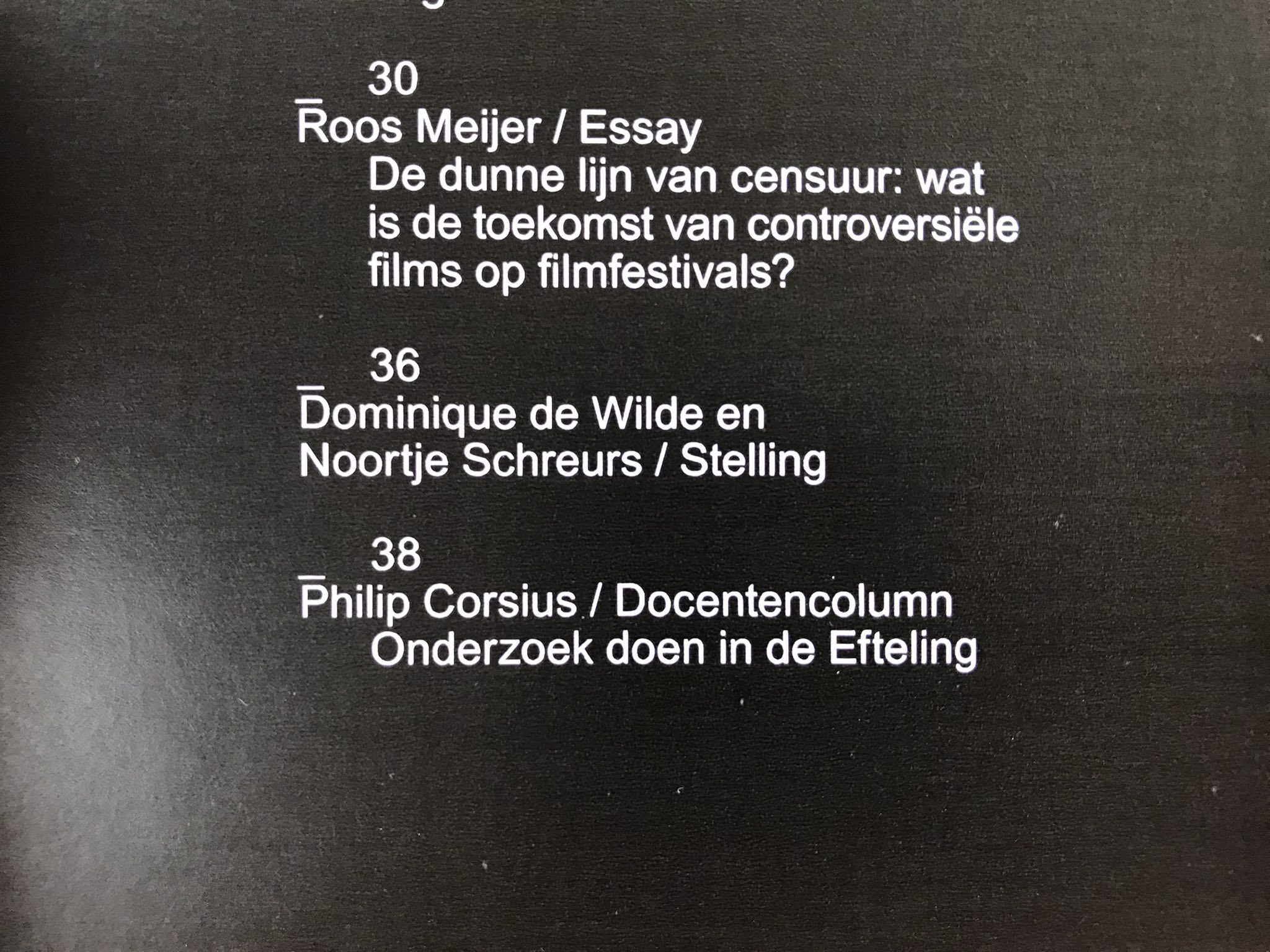
Lecturer’s column: Research at Efteling theme park – Philip Corsius
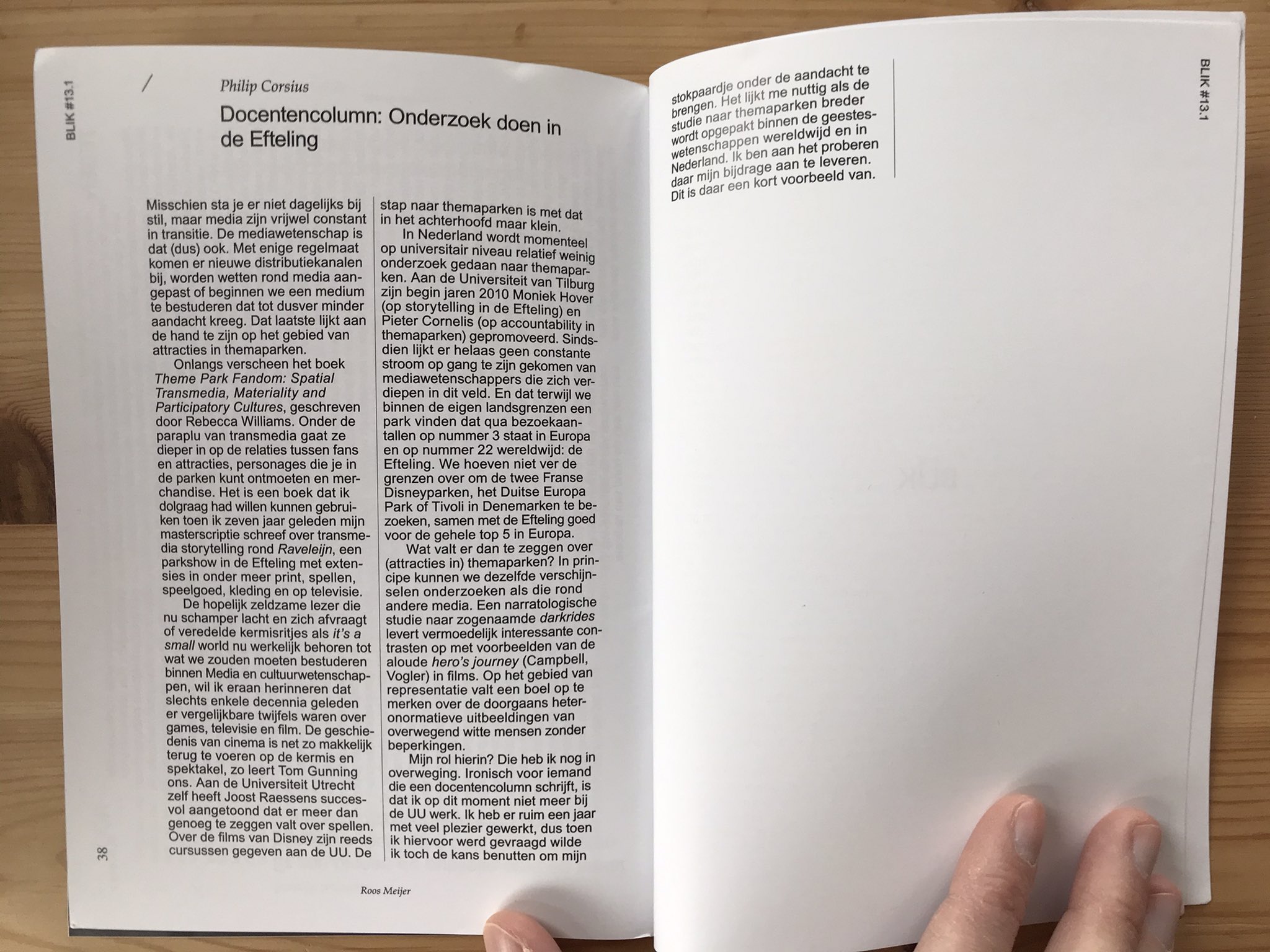
You might not stop and think about it every day, but media are almost constantly in transition. Media studies are (therefore) as well. On a more or less regular basis, new distribution channels are formed, laws concerning media get adapted or we start to study a medium that until then had not received as much attention. This last matter appears to be the case for attractions in theme parks.
Recently, Rebecca Williams’ book Theme Park Fandom: Spatial Transmedia, Materiality and Participatory Cultures was published. Under the umbrella of transmedia, she delves deeper into the relations between fans and attractions, characters whom you can meet in the parks, and merchandise. It’s a book I would have loved to have been able to use seven years ago, when I wrote my master’s thesis on transmedia storytelling in Raveleijn, a park show at Efteling theme park with extensions in among other things print, games, toys, clothes and tv.
The hopefully rare reader who is now laughing quietly, wondering whether glorified carnival rides such as “it’s a small world” truly belong to that which we should be studying in [our department] Media and Culture Studies, should do well to remember that only decades ago, similar doubts were raised about games, television and film. The history of cinema can just as easily be traced back to the fairground and to spectacle, as Tom Gunning taught us. At Utrecht University itself, Joost Raessens has successfully shown that there is quite a lot to be studied about games. Courses concerning Disney films have already been taught at UU. With this in mind, the step to theme parks is merely a small one.
At the moment, not a lot of university-level research is being done in the Netherlands when it comes to theme parks. The early 2010s saw Moniek Hover (storytelling by Efteling) and Pieter Cornelis (attraction accountability) obtain their PhD’s at Tilburg University. Since that time, it seems there has not been a steady stream of media scholars exploring this field, unfortunately. This is all the more surprising, when we consider we find the number 3 most-visited park in Europe and number 22 globally within our very borders: Efteling. We don’t need to go too far beyond those borders to visit both Disney parks in France, Germany’s Europa Park or Tivoli in Denmark, which together with Efteling round out the European top 5.
So what can be said about (attractions in) theme parks? Generally speaking, we could study the same phenomena we’re studying in other media. A narratological study of dark rides might well yield interesting contrasts to examples of the tried and trusted hero’s journey (Campbell, Vogler) in films. When it comes to representation, a lot can be noted about what are usually heteronormative depictions of mostly white people without disabilities.
My part in all this? I’m still pondering it. Ironically, for someone who writes a lecturer’s column, I’m currently not employed at UU. I have very happily worked there for over a year, so when I was asked for this, I decided to take the opportunity to write about this topic I’m so interested in. It seems useful to me, that the study into theme parks be taken up more broadly within the humanities, both worldwide and in the Netherlands. I’m trying to do my share in that. This is a brief example.
 Philip Corsius
Leave a reply